
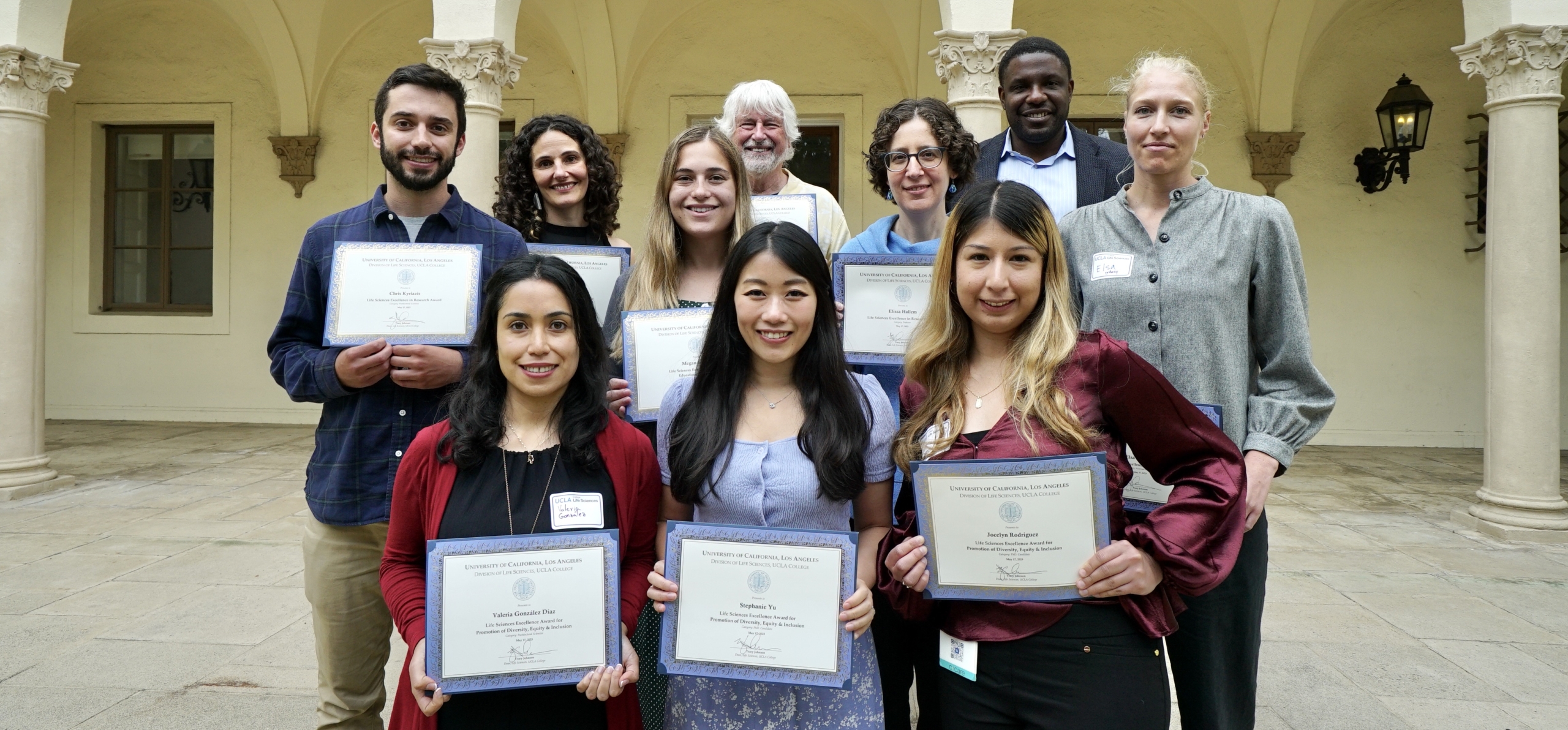
2023 Life Sciences Excellence Award Winners.
Top row: Chris Kyriazis, Elisheva Gross, Megan Imundo, Chris Evans, Elissa Hallem, Ketema Paul, Elsa Ordway • Bottom row: Valeria González Díaz, Stephanie Yu, Joselyn Soto • Awardees not pictured: Connie Firestone, Melissa Paquette-Smith, Bharat Venkat
On May 17, 2023, the UCLA Division of Life Sciences celebrated its annual Excellence Award winners. Here, below, are the recipients of this year’s awards.
Excellence Award – Life Sciences Administrative Staff
Connie Firestone • Department of Molecular, Cell, and Developmental Biology (Student Affairs Officer)
As a Student Affairs Officer for the past 14 years, Connie Firestone has been instrumental in the growth and acclaim of the MCDB undergraduate program. Under her guidance, the department saw its enrollment more than double. Her colleagues attribute this thriving environment to Connie’s exemplary leadership and her skill in managing the intricacies of the major. Above all, she is celebrated for her extensive expertise and the genuine care she brings to her work with students and faculty alike.
Excellence in Promoting Diversity & Inclusion
Ketema Paul • Department of Integrative Biology and Physiology (Professor)
In addition to exemplary research, teaching and training, Professor Ketema Paul has focused much of his time and energy on diversity and inclusion. Since 2018, he has served on Life Sciences Diversity Advisory Committee. And in 2020, Dr. Paul was appointed co-chair of Life Sciences Anti-Racism Taskforce. In this role, he co-lead the Taskforce in identifying solutions to barriers that prevent marginalized groups in academia from achieving their full potential. Also since 2018, professor Paul has been directing the UCLA-HBCU Neuroscience Pathways Summer Program, which recruits HBCU undergraduate students to UCLA for a summer research experience. In Fall 2022, professor Paul became the co-director of the Fellows Program at the Ralph Bunche Center for African American Studies. And recently, Dr. Paul was invited to chair the Vice Chancellor of Research’s HBCU Outreach initiative. In this capacity, Paul is building reciprocal research and teaching partnerships with HBCUs.
Valeria González Díaz • Department of Psychology (Postdoctoral Fellow)
Dr. Gonzalez, a postdoctoral fellow in the Department of Psychology, co-founded Fostering Equity and Accountability in STEM Together (FEAST) at UCLA. This group supports and advocates for graduate students and postdocs from historically marginalized backgrounds, and it performs outreach activities to demystify graduate school applications and to educate trainees about hidden curricula in academia. As the chair of the Postdoctoral Association at UCLA, Dr. Gonzalez advocates for more resources, for postdocs across campus, and has focused particular attention on supporting international postdocs, especially those from developing countries.
Jocelyn Rodriguez • Department of Molecular Biology IDP (Ph.D. Candidate)
As an executive board member of SACNAS, Jocelyn Rodriguez has been building community within the sciences and mentoring students. She has served as the Equity, Diversity and Inclusion Officer for the Biological Science Council for 2 years, initiating efforts to create affinity spaces across departments, to provide safe spaces for students to meet other students from similar backgrounds. Working with the Center for Education Innovation and Learning in the Sciences (CEILS), Rodriguez organized a D.E.I. workshop for faculty attending the Molecular Biology Institute (MBI) retreat last year, and is co-chairing the upcoming retreat this year.
Stephanie Yu • Department of Psychology (Ph.D. Candidate)
Stephanie Yu, a 5th year Clinical Psychology Ph.D. candidate, has mentored 24 psychology undergraduate students who have assisted in her in research. For the past four years, Yu has served as co-chair of UCLA’s Underrepresented Graduate Students in Psychology. In this role, she has been organizing and co-hosting quarterly workshops for UCLA undergraduate students, including an annual Research Assistant Recruitment Fair that connects undergraduates to labs with open research opportunities.
Excellence in Educational Innovation
Chris Evans • Department of Psychology (Professor)
Professor Evans has co-developed four courses with a focus on de-stigmatization of psychiatric illness, especially with respect to substance use disorders. Two of the courses, “Neurobiology of Bias” and “Mental Health Disparities”, fulfill UCLA’s diversity requirement, and illustrate how personal and societal decision-making exhibit implicit and explicit biases. Dr. Evans also co-developed a Cannabis and Cannabinoids course that explores societal aspects and the neuroscience around substance use disorders. Students present addiction science to 250 K-12 students each year, showing the biological effects of misused drugs and societal factors that could contribute to adverse outcomes.
Bharat Venkat • Institute of Society and Genetics (Assistant Professor)
As director of the UCLA Heat Lab, Professor Venkat leads an interdisciplinary team – of undergraduates, graduate students, postdocs, faculty and members of the community – to study heat and the unfair burdens it places on certain communities. Students in the Heat Lab create their own questions and work through the steps of research: refining questions, designing studies, and sharing their findings. As part of the Heat Lab, members also develop and implement a curriculum on thermal inequality, for students attending local elementary schools and high schools.
Elisheva Gross • Department of Psychology (Academic Coordinator / Lecturer)
Dr. Elisheva Gross led a major programmatic shift within the Applied Developmental Psychology minor, establishing 15 new partnerships with community-based organizations. By designing remote internship placements, she ensured that students could continue their fieldwork while addressing the urgent challenges of the pandemic, poverty, and systemic inequality. This initiative provided a vital bridge between academic study and real-world advocacy during a time of immense social need.
Melissa Paquette-Smith • Department of Psychology (Teaching Professor)
Professor Paquette-Smith has modernized UCLA’s Psych 10 curriculum by introducing active-learning labs and evidence-based pedagogical approaches. Beyond her work with undergraduates, she directs the training of all graduate-student TAs in the Psychology Department. Through this dual focus, she provides future professors with a foundation in evidence-based instruction while enhancing the learning experience for thousands of introductory psychology students.
Megan Imundo • Department of Psychology (Ph.D. Candidate)
A prolific educator and advocate for equity, Megan Imundo (Bjork Learning and Forgetting Lab) has supported nine psychology courses as a TA and served as a 2020-2021 Mind over Matter Teaching Fellow. Her commitment to accessible education is exemplified by her creation of an open-access test bank containing over 1,000 original questions for psychology and research methods. In Spring 2021, Megan further demonstrated her pedagogical expertise by designing and teaching Memory in the Age of Misinformation, a timely interdisciplinary seminar investigating the mechanisms behind falsehoods and conspiracy theories.
Excellence in Research
Elissa Hallem • Department of Microbiology Immunology and Molecular Genetics (Professor)
The neural basis of heat seeking in a human-infective parasitic worm
Human-parasitic worms infect over a billion people and they can cause devastating morbidity worldwide, with a particularly disproportionate impact on socioeconomically disadvantaged communities. For the first time, this work shows, the thermal mechanism through which some parasitic worms locate and infect humans – a finding that could be instrumental to mitigating the heavy consequence of threadworm infections.
Elsa Ordway • Department of Ecology and Evolutionary Biology (Assistant Professor)
Fighting climate change requires understanding how changing environments affect ecosystem functioning. This work is the first to show that it is possible to combine analytics with airborne imaging to characterize the tropical forest function without having to be on site – something which is very challenging for key, but remote, tropical regions.
Chris Kyriazis • Department of Ecology and Evolutionary Biology (Postdoctoral Fellow)
The critically endangered vaquita is not doomed to extinction by inbreeding depression
This work is a wonderful example of how new, sophisticated, population genetic simulations can be combined with ecological models to understand population survival. Importantly, this seemingly theoretical work has very direct real-world consequences by allowing us to understand what are they most crucial factors for the survival of the vaquita and thus providing a potential policy path to maximize the chances of survival of this endangered species.
Joselyn Soto • Neurology Interdepartmental Program (Ph.D. Candidate)
Astrocyte–neuron subproteomes and obsessive–compulsive disorder mechanisms
This work is the very first demonstration of how both astrocytic and neuronal molecular mechanisms contribute to the manifestation of psychiatric phenotypes, which provides novel avenues to understand and intervene in mitigating disorders that affect a significant portion of adults worldwide.