
When was the last time you changed your mind about someone because of a word used to describe them? Have you ever wondered about the hormones involved in how animals create groups?
Undergraduates at UCLA are actively investigating these questions, and many more. Research is a cornerstone of the undergraduate experience at UCLA, with more than 4,000 Bruins participating in research or creative inquiry each year. UCLA’s two Undergraduate Research Centers (URCS) — one dedicated to the sciences and one to the humanities, arts and social sciences — provide a support network that makes research possible for all students. The URCs connect students with the mentorship, funding and community to help them succeed as researchers.
Undergraduates who engage in research early are better positioned to become the scientists, physicians, engineers, policymakers and entrepreneurs who will address challenges across industries. Developing critical thinking skills and firsthand experience with complex problems prepares them for careers in academia and industry, and for leadership roles where evidence-based decision-making matters most.
Each year, UCLA Undergraduate Research Week celebrates these students and their work. This year’s special “Bruin Research Powers Progress” panel brings together eight researchers whose projects span biology, law, sociology, education, psychology and neuroscience.
Here, below, is what Life Sciences’ panelists are working on and why it matters. Read about all eight panelists (and watch their video) in the full UCLA Newsroom article by Kayla McCormack.
The live panel took place on May 18, via Zoom.
How does mitochondrial metabolism change as neurons develop?

Courtesy of Clarissa Carillo
Clarissa Carillo
Clarissa Carrillo, a fourth-year biology major, is researching how mitochondrial metabolism changes as neurons develop. Most people know mitochondria as the powerhouse of the cell, but they also act as signaling organelles, sending chemical signals that influence how cells grow and behave. Carrillo is tracking how those signals change as neurons, extracted from pregnant rats, mature over 23 days. Understanding how metabolic pathways impact neurons as they mature could eventually lead to a deeper understanding of diseases like Alzheimer’s and Parkinson’s, both of which are linked to mitochondrial dysfunction.
Growing up in the Imperial Valley without much access to research institutions, Carrillo didn’t see a clear path to a research career. Through URC programming to support academic excellence and professional development for students, like PEERS and CAMP, she found her community and place in research.
“I believe that progress in science is not only about what we discover, but about who is empowered to make those discoveries,” Carrillo said.
How do heat and noise impact a developing brain?

Courtesy of Amaya Ellis
Amaya Ellis
As climate change drives temperatures up and cities grow louder, Amaya Ellis, a third-year human biology and society major, is asking what those stressors do to a still-developing brain. Using zebrafish larvae, she exposes fish to heat, noise or both during a critical developmental window, and then tracks their behavior. Her early results show the two stressors produce opposite behavioral effects, suggesting they disrupt brain circuits through entirely separate pathways. Communities that bear the highest levels of heat and noise are often those with the fewest resources to buffer them.
“Much of the discussion around neurodevelopmental conditions focuses on treatment after symptoms appear,” Ellis said. “My goal is to contribute to a more prevention-focused perspective. If we can better recognize these risks early on, it may help reduce negative outcomes over time for individuals and families.”
How does oxytocin impact social cohesion?

Credit: Philena Nguyen
Alexandra Tabacu
Alexandra Tabacu, a fourth-year human biology and society major, began asking her research question not in a laboratory but during weekly volunteer shifts at a Hollywood clinic serving unhoused individuals. Those conversations left her wondering about the biological foundations of community itself.
Now she is researching how oxytocin — the hormone associated with human bonding — shapes early social behavior in juvenile African cichlid fish. Fish engineered to lack isotocin, the fish version of oxytocin, show measurably reduced social cohesion. Her results suggest the roots of belonging are ancient, preserved by evolution across hundreds of millions of years.
“Ultimately, I hope this work contributes to a future where fostering empathy, trust and belonging is treated not just as an ideal, but as a necessity.”
How do families navigate a fragmented healthcare system?
Courtesy of Gianna Karkafi
Gianna Karkafi
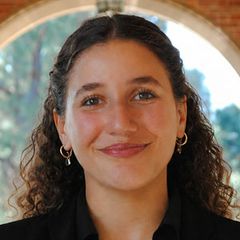
Lebanon ratified the U.N. Convention on the Rights of Persons with Disabilities in 2007. For many families seeking care for children with intellectual and developmental disabilities (IDDs), those rights remain largely out of reach. Gianna Karkafi, a third-year double major in neuroscience and disability studies, is documenting what those families experience — through caregiver interviews and surveys — amid Lebanon’s political and economic crises. Her research has found that parents have become the healthcare system by necessity, coordinating fragmented care with little institutional support.
“Challenges such as fragmented healthcare systems and unequal access to services occur in many settings around the world,” Karkafi said. “I hope the research can help inform organizations, clinicians and policymakers working to improve disability services in resource-constrained settings.”
How does a single adjective shape our perception of someone?

Courtesy of Tamanna Tikoo
Tamanna Tikoo
Think back to that opening question — about the word that changed your mind about someone. Tamanna Tikoo, a third-year psychology major, has made that concept the subject of her research. She examines how the breadth of trait adjectives — broad words like “reliable” versus narrow ones like “punctual” — shapes lasting impressions of others. Her preliminary results found that narrow negative labels are the most likely to stick, shaping judgments even when evidence is limited. In courtrooms and newsrooms, that finding carries serious consequences.
“If we can become more aware of how our words trap people in certain boxes, we can create a more just society where people are judged by their full complexity rather than a convenient adjective,” she said.
The researchers profiled here are presenting on May 18, but Undergraduate Research Week celebrates the work of hundreds of students from May 18 through May 22. Browse the full schedule of events here.
Watch an audio description of the video at the top of this article at this link.