Excerpted from a Father’s Day feature article, originally published in UCLA Magazine.
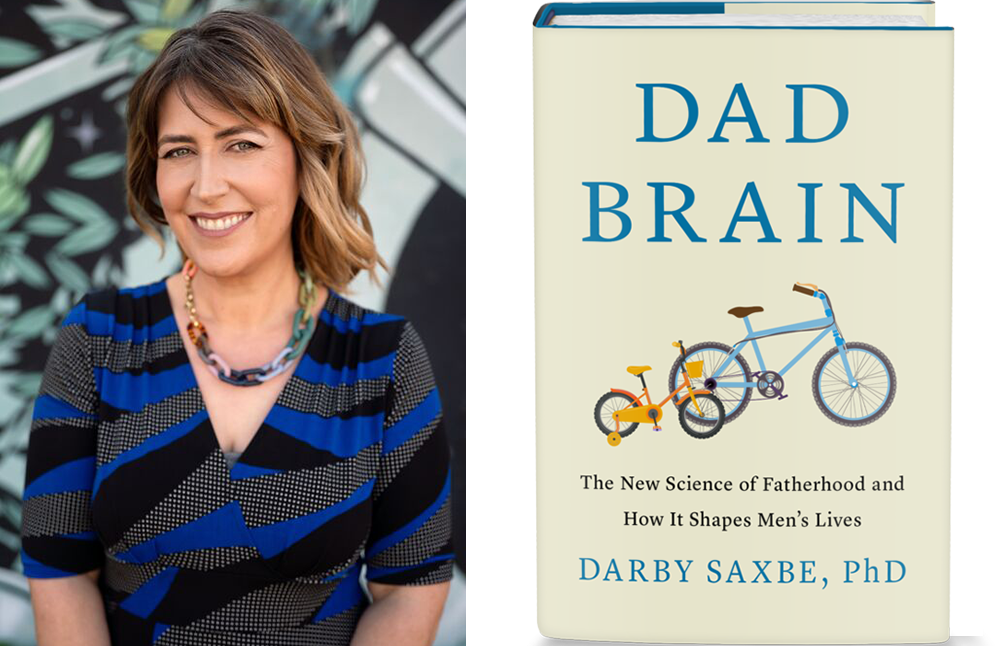
Darby Saxbe is a clinical psychologist, neuroscientist, and professor of psychology at USC. She received her masters and Ph.D. in clinical psychology from UCLA and recently authored the new book, Dad Brain: The New Science of Fatherhood and How It Shapes Men’s Lives.
By Jonathan Riggs
“Fatherhood is both innate and learned”
“Motherhood and fatherhood are both very special,” says Darby Saxbe M.A. ’04, Ph.D. ’09, one of the world’s only researchers collecting longitudinal neuroimaging research on new fathers. She pauses. “But there are a couple really cool things about fatherhood.”
Saxbe’s eyes sparkle. She loves talking about all the cool things, not just a couple, and her wealth of findings has been cataloged — with a sharp sense of humor — in her new book, Dad Brain: The New Science of Fatherhood and How It Shapes Men’s Lives.
“If we’re interested in neuroplasticity — because who isn’t, really? — dads don’t experience pregnancy directly, but we also see all these neurobiological changes in them,” she says. “The idea that our experience and our investments can change us physically and mentally is really powerful.”
That’s right — while it’s well-known that many aspects of mothers’ bodies change during pregnancy and after childbirth, Saxbe’s research shows that similar things happen to fathers. Giving new meaning to the term “dad bod”: Across multiple species, studies show that the archetypal “dad bod” body type sends a clear message of fatherhood readiness and ability.
Going even deeper, scientific scans demonstrate that the brains of new fathers lose volume in the same regions as those of new mothers. Instead of being cause for alarm, however, this streamlining actually reflects a stronger bond with their child and a more intense focus on parenting. It’s also further proof that human brains and bodies are adaptable based on what they’re called upon to do, instead of being hardwired to fulfill certain prescribed roles.
“I’ve heard people argue against paternity leave because mothers are supposedly wired to take care of kids, and therefore they’re the ones that should be home,” Saxbe says. “But when you start to recognize that the research is telling a different story and challenging our assumptions, it opens up a lot more possibility for flexibility.”
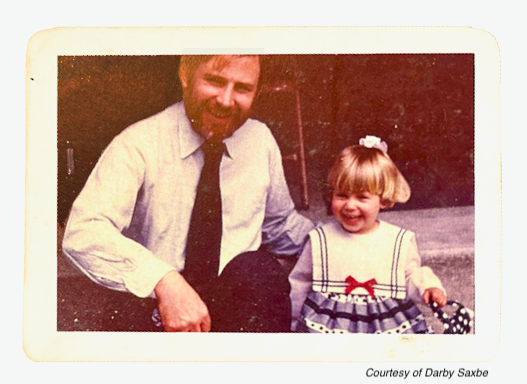
Saxbe experienced this firsthand with her own father, about whom she writes movingly in her book. A hands-off parent, her father at first became unmoored when his wife left the marriage and he suddenly had primary custody of four children as a single dad.
A young Darby Saxbe with her father. The Bruin has just published a provocative new book about how fatherhood deeply changes men’s lives, both emotionally and physically.
This sudden new role caused him to unexpectedly become a reinvigorated person and parent — sewing custom patches for his kids’ backpacks, designing letterhead for the family’s cats, building a three-story treehouse. And it made an indelible impact on Saxbe’s and her siblings’ lives.
The same was true of her mother’s second husband, who deeply enjoyed doing all the family’s cooking and errands. Both men — and, specifically, their willingness to grow and change — helped inspire Saxbe’s scientific direction and her book.
“I had two men in my life who were really involved in raising us, and I think that’s surprisingly unusual, especially as someone who grew up in the ’80s and ’90s,” she says. “As I say in the book, since humans have evolved to have an early childhood that requires such extensive care, we need all hands on deck to raise the next generation.
“Helping men feel empowered and welcomed into the caregiving web is really helpful to kids, it’s really helpful to moms, and it’s really helpful to dads themselves,” she continues, “because I think there’s a lot of meaning and a lot of purpose that can come from taking care of others.”
Today a professor of psychology at USC who proudly plays in a “mom band” originally formed at her kids’ school — the Dahli Mamas — Saxbe is proud that she can represent both Southern California universities that helped shape her and her work.
“So much of the research in my book was done on those two campuses,” she says. “It’s so important, too, especially at a time with all these funding cuts happening with science, for us all to acknowledge the value of higher education in advancing knowledge.”
Saxbe closes Dad Brain by describing a letter she received from her father 10 years ago that shed new light on how embracing being a dad didn’t constrict his life, but instead gave him a new and better one.
“[Caring for my siblings and me] gave him purpose and helped him put one foot in front of the other when he wanted to give up,” she writes. “Love transformed him, just as it transforms millions of men around the world who are engaging in the work of caring for others every single day. This book is for them.”
***